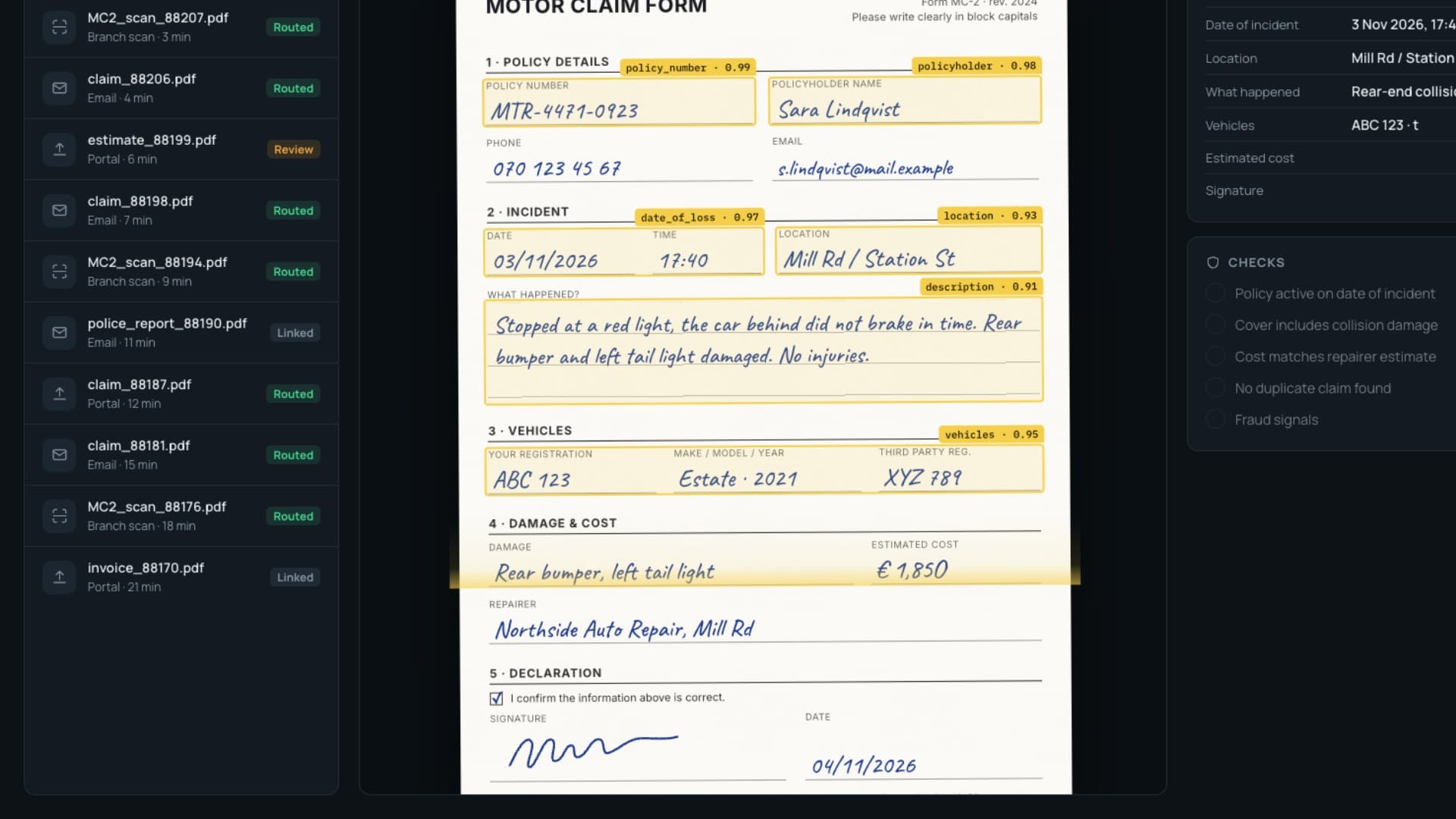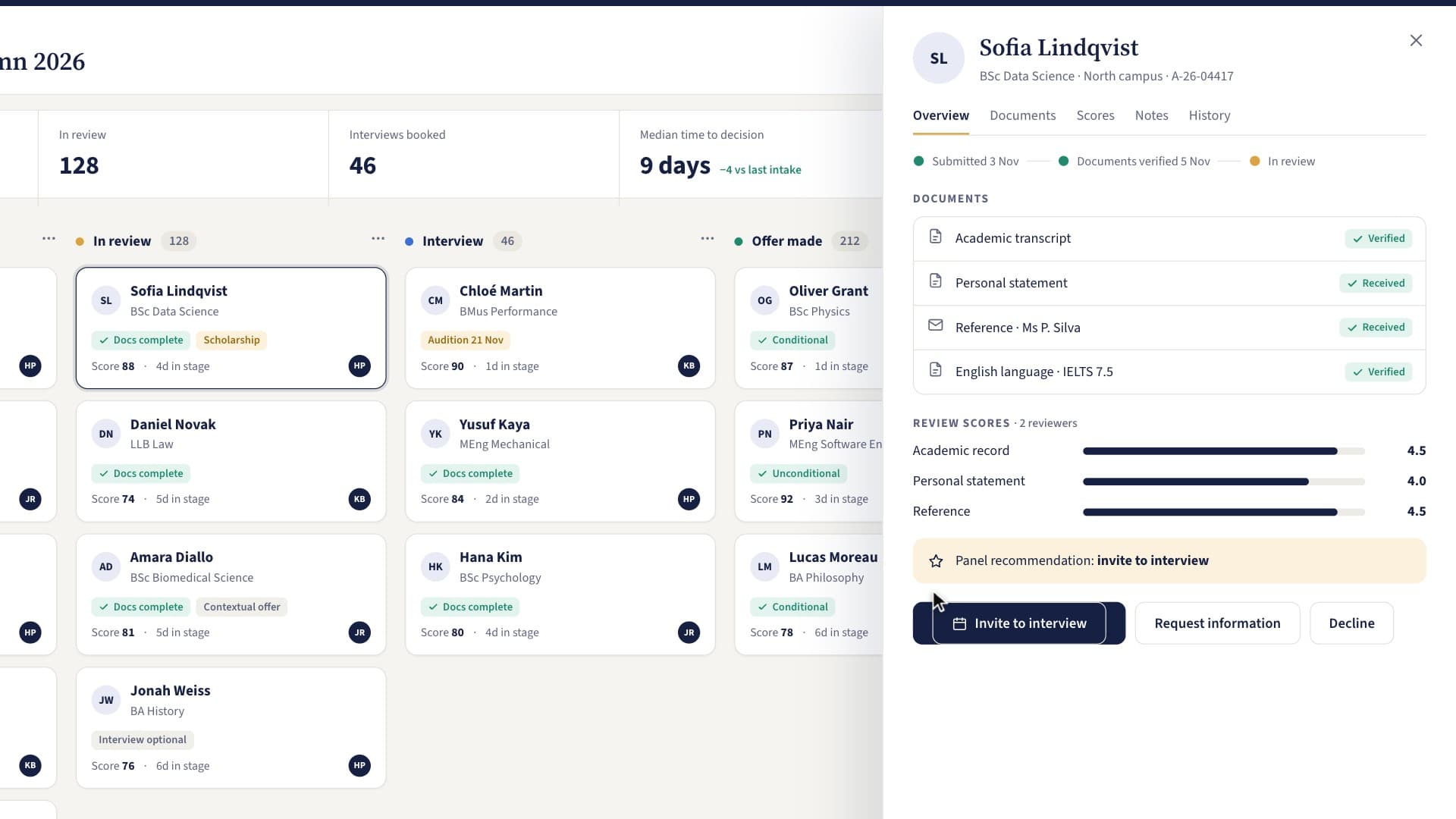
Admissions
Work04 / 06Education2024Sample
A single digital front door for applications, reviews and offers across every campus.
SampleIllustrative case study with placeholder figures — replace it with your own project.
- Client
- Multi-campus university
- Industry
- Education
- Year
- 2024
- Platforms
- Applicant portal
- Staff workspace
- Engagement
- 12 months(placeholder) · phased across five campuses
- 7(placeholder) · people on the team
The problem
Five campuses, five processes, one frustrated applicant.
Each campus had its own forms, inbox and spreadsheet. Applicants applying to two programmes filled in everything twice; staff chased documents by email; nobody could see the whole intake.
The university wanted one front door for applicants and one workspace for staff — without forcing every faculty into an identical process overnight.
- campus admissions offices
- 5(placeholder)
- campus admissions offices
- applications a year
- 18,000(placeholder)
- applications a year
Our approach
Harmonise the core, configure the edges.
Strategy
One process model, many variations
We mapped every campus process and found a shared core of six stages. Faculty-specific steps became configuration, not custom code.
UX & UI
Accessible to every applicant
The applicant portal meets WCAG 2.2 AA and works on low-end phones, because many applicants apply from a phone.
Engineering
Modernise beside the legacy system
New services took over admissions while the student records system stayed in place, connected through a single integration layer.
The product
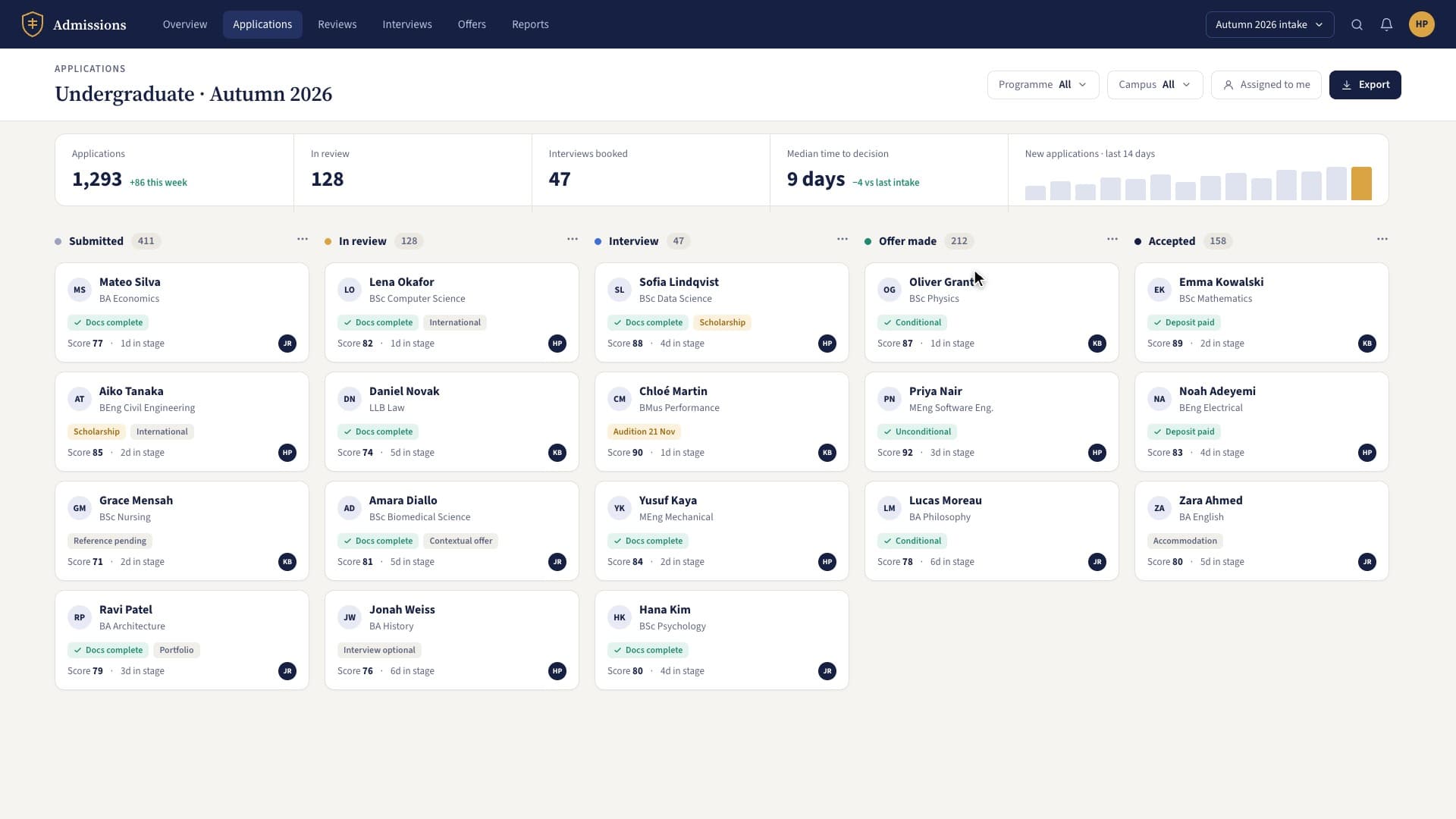
One workspace for every campus
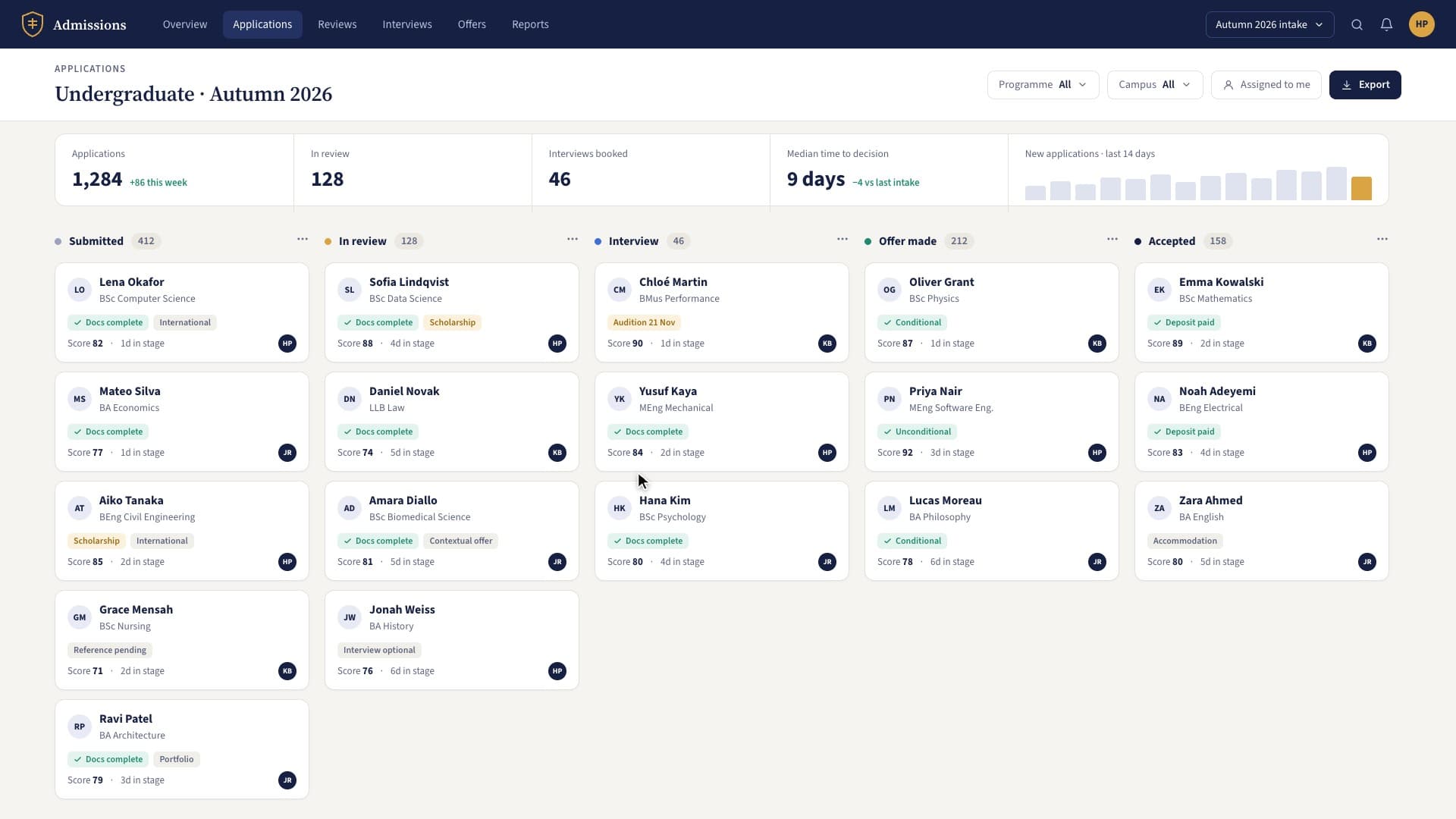
A shared pipeline
Every application moves through the same stages, with counts per campus and programme updated live.
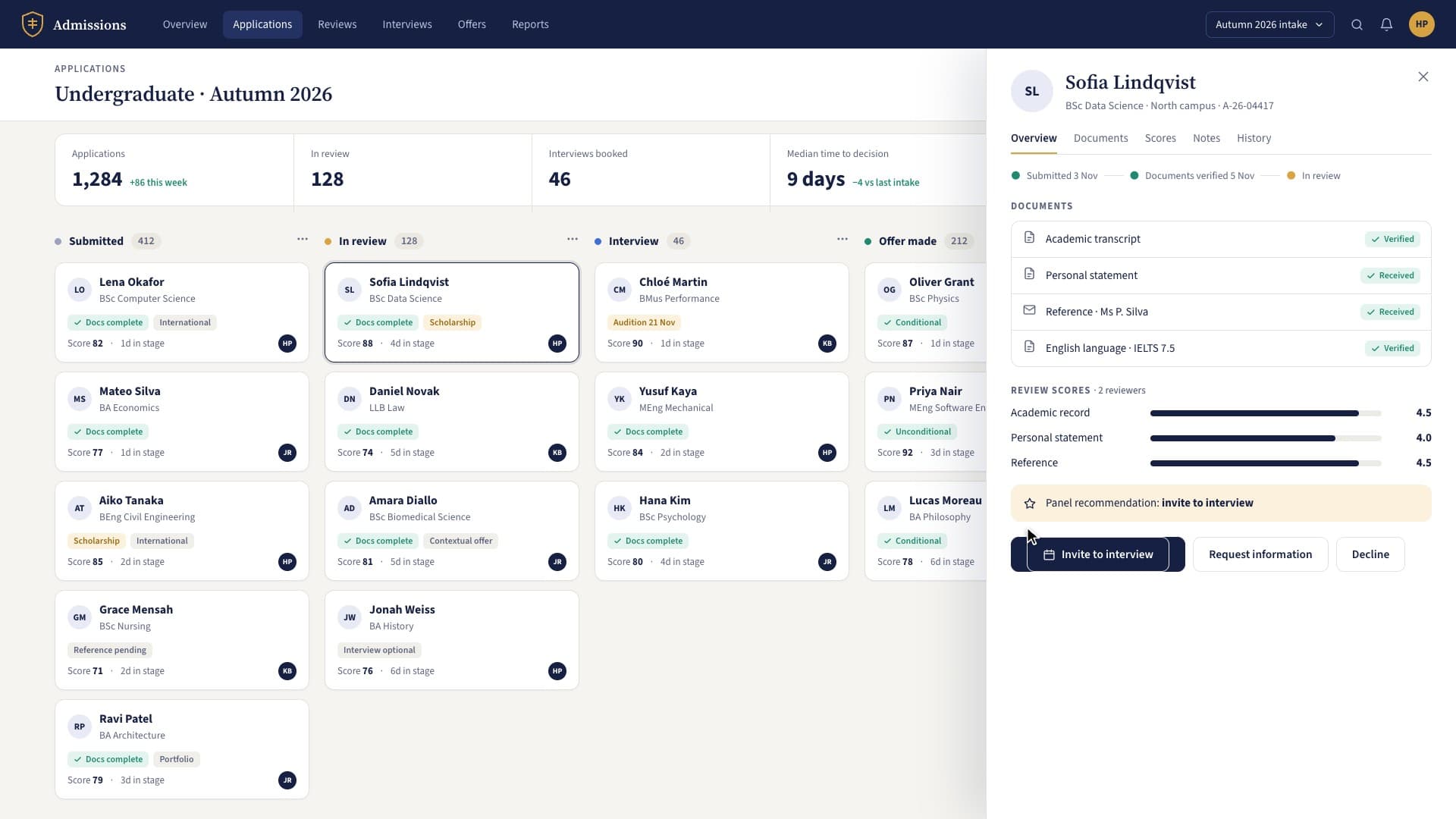
Review in context
Verified documents, reviewer scores and the panel recommendation sit next to the board — no more attachments in inboxes.
Decisions that notify
Inviting, offering or declining notifies the applicant and updates the student record in one step.
Architecture
New services in front, the student record behind
Applicants and staff sign in through the university's identity provider. An admissions service owns the process; an integration layer keeps the student records system in sync.
Configured, not forked
Campus and programme rules are configuration, so a new faculty process takes days, not a release.
Safe documents
Uploads are virus-scanned, checksummed and stored with retention rules that match policy.
Legacy stays stable
The student records system receives clean, validated updates and nothing else.
Challenges solved
Where it got hard
Every campus believed its process was unique.
Solution: Shared workshops showed most differences were in wording; the real ones became configuration.
Years of applications lived in spreadsheets.
Solution: A migration with validation reports per campus moved history across before the new intake opened.
Peak days bring a quarter of the year's traffic.
Solution: Load tests at three times the expected peak, with autoscaling and queue-based document processing.
Outcome
One front door, and an intake everyone can see.
Applicants apply once for any programme. Staff across campuses work in one workspace, and leadership sees the intake as it happens.
- median time to decision
- −4 days(placeholder)
- median time to decision
- admissions systems
- 5 → 1(placeholder)
- admissions systems
- WCAG 2.2 conformance
- AA(placeholder)
- WCAG 2.2 conformance
Technology
- Experience
- WCAG 2.2
- Applications
- TypeScript
- Angular
- Java
- Spring
- Data
- PostgreSQL
- Infrastructure
- Keycloak
- Kubernetes