Work05 / 06Insurance2025Sample
Claims Intake
Document AI that reads incoming claims, checks them against policy rules and routes them in minutes.
SampleIllustrative case study with placeholder figures — replace it with your own project.
- Client
- Motor and property insurer
- Industry
- Insurance
- Year
- 2025
- Platforms
- Web
- Internal API
- Engagement
- 6 months(placeholder) · pilot to production
- 5(placeholder) · people on the team
In one sentence
Every claim used to start with someone retyping a PDF. Now it starts with checked, structured data — and a person only looks where the system is unsure.
The problem
Claims arrived as email attachments, scans and photos.
Handlers spent the first part of every claim reading forms, retyping fields into the claims system and checking the policy by hand. Backlogs grew after every storm.
The insurer wanted to automate intake without losing control: every automated decision had to be explainable to a regulator and reversible by a person.
- claims received on a normal day
- 1,200(placeholder)
- claims received on a normal day
- average wait before first review
- 3 days(placeholder)
- average wait before first review
Our approach
Measure first, automate second.
Strategy
An evaluation set before a model
Historical claims, labelled together with the insurer's handlers, defined what 'accurate enough' meant for each field.
UX & UI
Show the evidence on the page
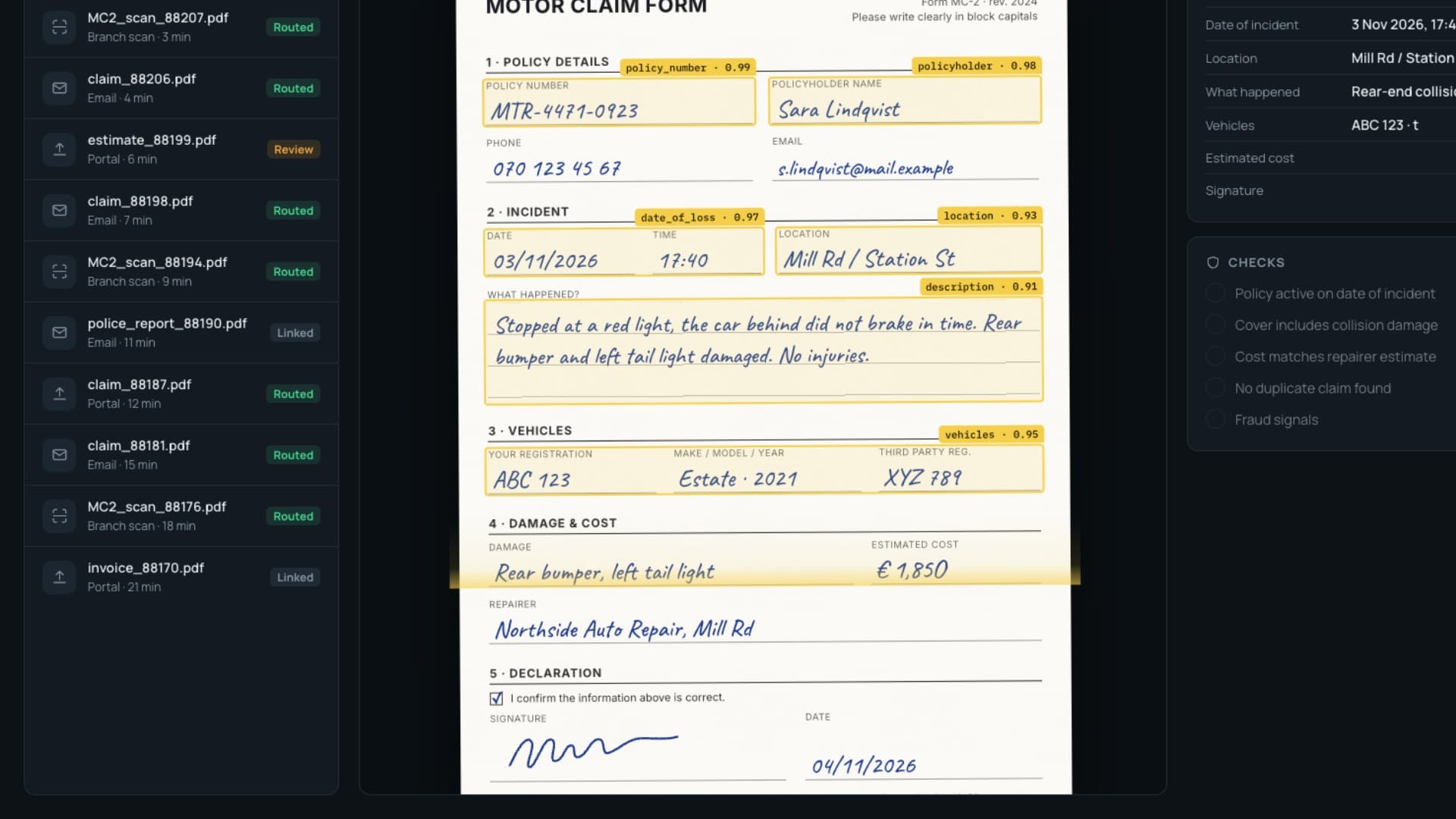
Extracted values are drawn on the original document with their confidence, so a reviewer can verify any field in a second.
Engineering
Thresholds, not trust
Fields below the agreed confidence go to a person. Rules, not the model, decide whether a claim is fast-tracked.
Architecture
A pipeline with people at the checkpoints
Documents flow through classification, extraction and validation. Each stage writes its result and confidence, so any decision can be traced back to the page it came from.
Confidence per field
Every extracted value carries a score and its location on the page; thresholds were agreed per field with the claims team.
Rules decide, models read
Fast-tracking is a policy rule over validated data, which keeps decisions explainable.
Watching for drift
A weekly sample is re-labelled by handlers and scored, so accuracy changes are caught early.
Challenges solved
Where it got hard
Handwriting, stamps and photographed forms.
Solution: A layout-aware extraction step and cross-checks against attached repair estimates resolve most unclear amounts.
Regulators expect explainable decisions.
Solution: Each step stores its input, output, confidence and the rule applied, exportable per claim.
Volumes spike after storms.
Solution: Queue-based processing scales out automatically and degrades to manual review rather than failing.
Outcome
Faster first response, without giving up control.
Most claims are classified, extracted and validated before a handler opens them. People spend their time on judgement calls rather than data entry.
- median time from inbox to routed
- 2m 14s(placeholder)
- median time from inbox to routed
- of claims fast-tracked
- 71%(placeholder)
- of claims fast-tracked
- field-level accuracy on the evaluation set
- 0.95+(placeholder)
- field-level accuracy on the evaluation set
Technology
- Applications
- Python
- FastAPI
- Automation & AI
- Document AI & OCR
- LLM APIs
- Evaluation pipelines
- Data
- PostgreSQL
- Infrastructure
- AWS
- Terraform